

Gen-Z is Accidentally Right About Phone Photography
They've taken a different path to get there, but we agree that phone photography sucks.
It’s often said, rather platitudinously, that “age is just a number,” or “you’re only as old as you feel,” or “[larger number] is the new [smaller number],” but there is one unfailingly objective indication of how much you’ve aged, and it’s how much disdain you have for people younger than you. Specifically the generation just after your own - the ones who are close enough in age to you that they should know better, so it’s particularly offensive that they don’t.
For me, those people are Generation Z (aka Gen-Z, or Zoomers), born between 1997 and 2012, and I don’t like them very much. They display a pathological dependence on technology while having almost no practical knowledge of how it works, rely heavily on influencers and social media to decide what to consume, are crippled by FOMO and general anxiety, don’t drink very much, and like the Star Wars prequels. Utter degenerates, really.
Their stock has been rising a bit lately though, at least in my eyes, because apparently they’re ditching their smartphones for old compact digital cameras for personal photography.
Before I give these 20-something broken clocks too much credit, I should point out the simplest explanation for this, which is your average, run-of-the-mill cycle of abandonment → dormancy → revival. Counterculture, in a word. This happens most conspicuously in the fashion industry, but it’s a technological phenomenon as well. In my own lifetime I’ve experienced it with vinyl records and film photography, neither of which I grew up with but both of which I embraced when I was in my late twenties, the same age as the most mature members of Gen-Z today.
This is the most likely explanation for the Zoomers’ widespread rejection of the iPhone for their snapshots: neophilia. Neo to them, anyway - many of you reading this probably had a compact digital camera in the 2010s and don’t miss it in the slightest. (I did, and I don’t.) You might even be struggling to imagine exactly how an obsolete, plasticky little point-and-shoot with an embarrassing designation like Coolpix or Cyber-shot written on it could be appealing to anyone anno domini 2026.

After all, these things were designed for convenience, not for bleeding-edge image quality. (See above - a photo I took in 2003 with a FujiFilm FinePix 3800, a 3-megapixel camera that cost $450 at the time, or almost $800 in today’s money.) And yet, the Zoomers are gobbling them up and partying like it’s 1999.
While the novelty argument may well be the only explanation one needs to make sense of this, I’d like to offer a complementary theory, which goes like this:
Smartphone photography sucks.
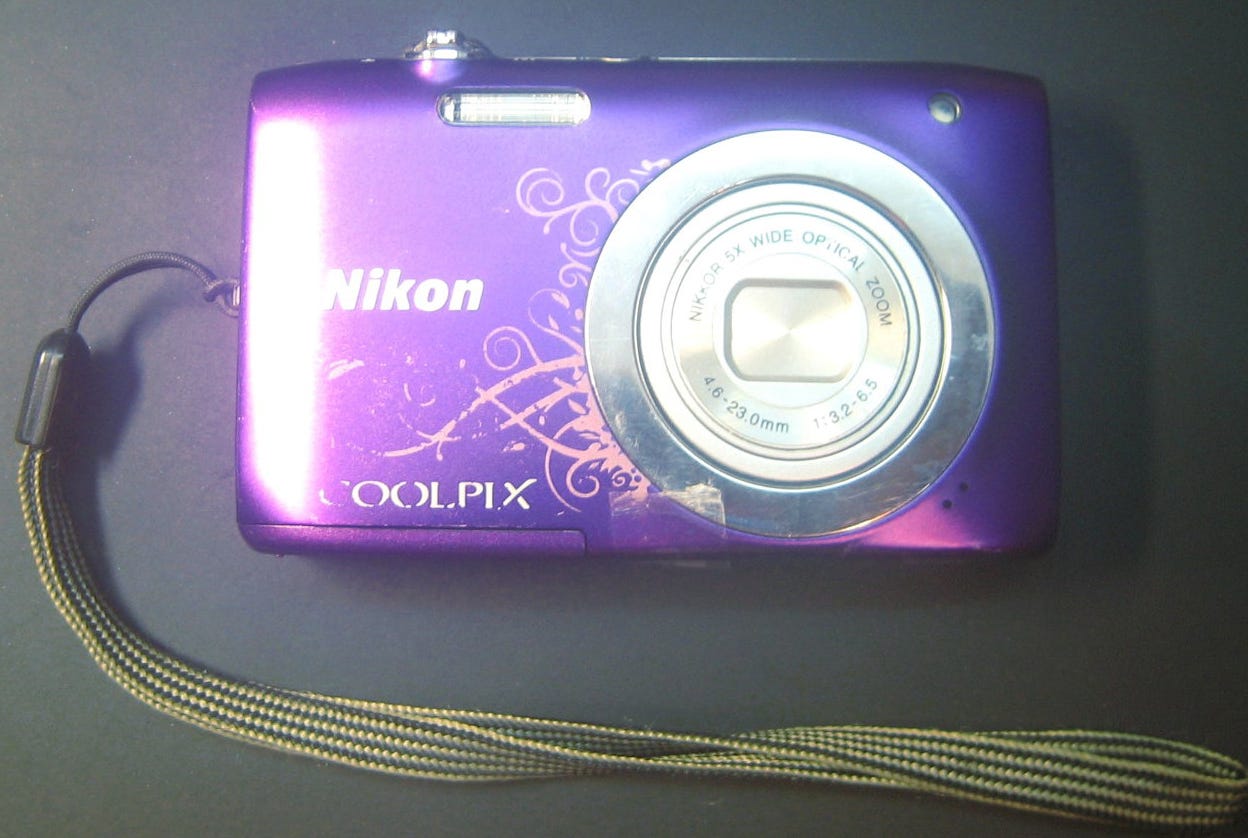
Before you start angrily typing in the comments, some throat-clearing and clarification. I am not commenting on the quality of the photographs that modern smartphones produce. (I still believe that phones are technologically inferior to actual cameras and not for any serious photographic work, but we can argue about that some other time.) I’m making an observation here about the experience of using a smartphone to take photographs. That’s the thing that sucks. Not necessarily the result, but the process. Taking a photo with that shameful purple Nikon above is a more satisfying experience, I would argue, than taking the same photo with the latest iPhone.
To understand why smartphone photography is so dissatisfying an experience, we need to zoom out a bit and talk about touchscreens in general. Crudely described, a phone is really just a slab of glass, plastic, and metal with a giant touchscreen on one side and a camera bump on the other. While touchscreens offer a lot in the way of accessibility and space saving over other input devices, they’re also hopelessly imprecise and exhausting to use extensively, even with haptic feedback or a stylus. If you have to type a long string of text, for example, doing that with your thumbs on a flat piece of glass is a vastly inferior experience to doing the same with ten fingers on a physical keyboard. Hell, even typing with your thumbs on a little plastic keyboard à la Blackberry was preferable, and many people lamented the death of the those devices for that reason alone.
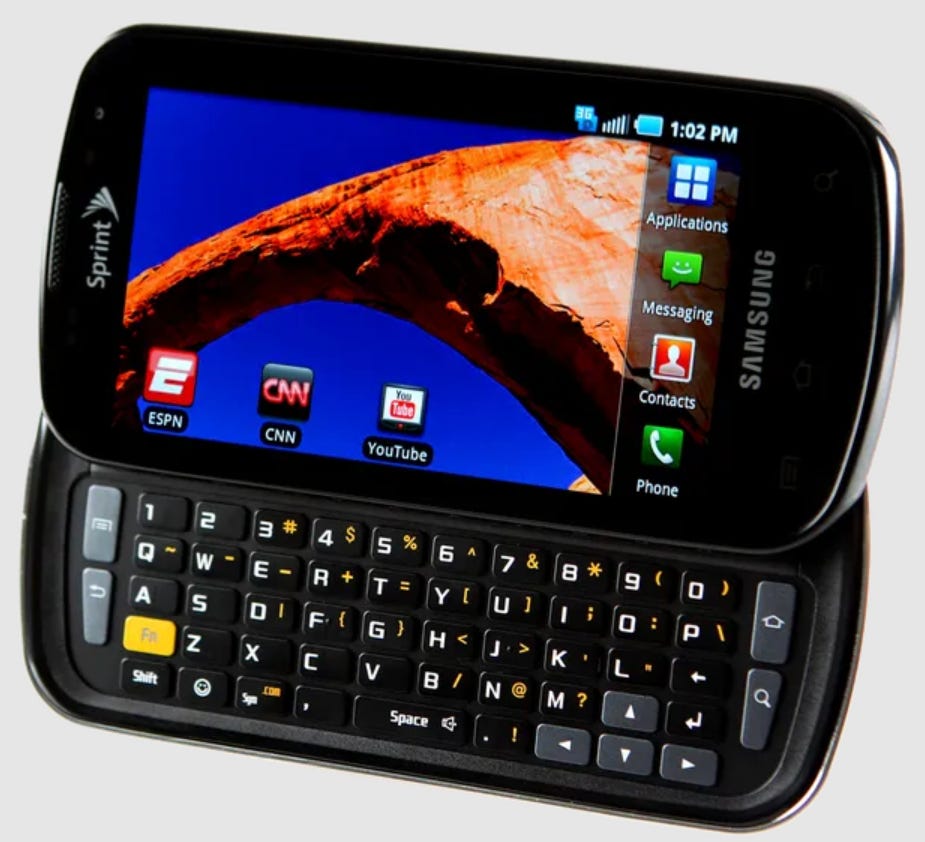
I was a relatively late adopter of the smartphone, but when I did finally hop on the trend, my choice was the Samsung Epic 4G (above), which featured a slide-out full QWERTY keyboard. If any major manufacturer offered something like this right now, I’d probably buy it. Perhaps this isn’t as crazy as it sounds: there’s a company called Clicks that is taking preorders for an external physical keyboard attachment for MagSafe-equipped phones and is also cooking up a bespoke Android phone with a Blackberry-style physical keyboard.
But phone tech isn’t the only domain in which touchscreens are being seen for the limited and imperfect technology that they are - automotive interior design is now moving away from screens in favor of physical stalks, switches, toggles, sliders - anything we humans can wrap our little jointed digits around. This has gone beyond simple preferences based on user feedback; the EU New Car Assessment Program (NCAP) says that new car models will need to use physical controls instead of touchscreens in order to earn their highest rating. Even Jony Ive, who worked at Apple and was instrumental in bringing touchscreens to all of our palms, has called them “the wrong technology” to use in cars because they can’t be operated safely (i.e. without the driver looking away from the road).
I think you can see where this critique is going, vis-à-vis smartphone cameras. Just to run down the list quickly, here are the biggest problems with the experience of taking photographs with a touchscreen slab, from my own perspective:
The screen doubles as the viewfinder, but outside in bright light it can be too hard to see clearly.
The screen doesn’t articulate in any direction, so if you want to take a photo of something at some angle, you can’t see what you’re photographing.
Trying to adjust individual settings in some kind of pro/manual mode is difficult to access in a camera app and awkward to use (at least on my Pixel 8 Pro).
Phone cameras do not have adjustable apertures, eliminating one of the key elements of control and creativity in photography. That’s one third of the exposure triangle gone. If you want to adjust the other two elements (ISO and shutter speed) manually, you have to do so by flipping through menus within a piece of software - not something you can be doing constantly if you actually want to take some pictures. Manual mode on a phone camera is impractical, bordering on pointless.
There’s not a predictable and consistent relationship between pressing the shutter button (which isn’t even a button at all if you’re touching the screen) and the camera taking a photo, making photography of moving objects a total crapshoot.
Distractions! There’s nothing to stop notifications from other apps interrupting the moment and stealing your attention when you’re trying to take a picture.
Software lag. If I set my phone to take photos in its highest resolution, there’s a significant processing time between pressing the shutter and having the image be finished and viewable. If I take multiple photos too quickly, the phone doesn’t allow me to take more photos until it’s caught up.
No interchangeable lenses. Most high end cameras now have something like a three lens loadout (wide, standard, tele) to cover most things. That’s all you get. (Companies have been trying to get people to buy external lenses to attach to their phone cameras for years, but they never seem to catch on.)
In short, despite my phone being a fairly capable photographic device from a technical standpoint, the practical limitations of using it for anything other than casual snapshots when I don’t have an actual camera with me or for quick sharing on social media render it less useful than its specs suggest it should be. To put a finer point on it, I would never reach for a smartphone if I were going on a photo walk. If photos are the point, my phone is demoted to navigation tool, and I grab the OM-1.
It should be clearer now how even a plasticky purple point-and-shoot like that Nikon atrocity above would offer a much more satisfying experience of photography to the user, even if the photos it produces are underwhelming technically. (For Gen-Z, incidentally, this is also a feature rather than a bug - they find the imperfect, low-res renderings charmingly retro without the need for filters.)
Furthermore, a touchscreen fails to take advantage of the fact that a typical human has two fully articulating arms and hands with ten fingers, all independently operable for controlling, adjusting, and actuating. While that little Coolpix gadget doesn’t have all of the fancy dials and buttons that an SLR has, you can at least hold it up in front of you in your right hand and operate it deftly, thumb on the back controls and index finger on the shutter. You can scroll through your photos without distraction and show them to friends without the interruption of immediately having to send them to everyone (because you can’t). These are all positive things for taking photographs.
If you remain skeptical, remind yourself of how taking a photograph with your phone works:
Retrieve the device from your pocket or bag.
Go through whatever unlocking procedure is required to gain access to it.
Get distracted by notifications and spend 17 minutes scrolling an app before you remember why you unlocked your phone.
Open the camera app.
Hold your phone out in front of you, probably with two hands so you don’t drop it, which you will often anyway, possibly into water or a ravine.
Swipe away more notifications so that you can actually see the screen and frame your shot.
Press the shutter on the screen and hope that you didn’t miss the button, which you can’t feel because it isn’t actually a button but a designated area of pixels in the shape of a button.
Post the photo on social media and wait for validation that it’s good and that you therefore have value as a person.
Now compare this with the same process on the purple Nikon from the Bush (GW) administration:
Retrieve camera (if it’s not already in your hand or hanging on a wrist strap).
Press the shutter button to wake it up.
Take a picture.
I don’t know… one of those just seems a lot more straightforwardly pleasant than the other if you’re just trying to take a picture. The most shocking part of all of this is that I can see myself moving into a new stage of life. Having passed through old man yells at cloud, I’ve settled into the kids are alright. So it goes.